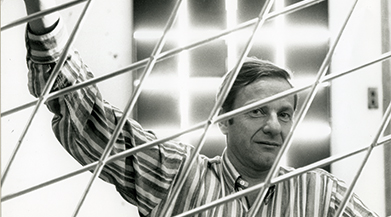
The Espace de l'Art Concret is delighted to present, for the first time in France, the work of the Swiss physicist, teacher and artist Jürg Nänni (1942–2019).
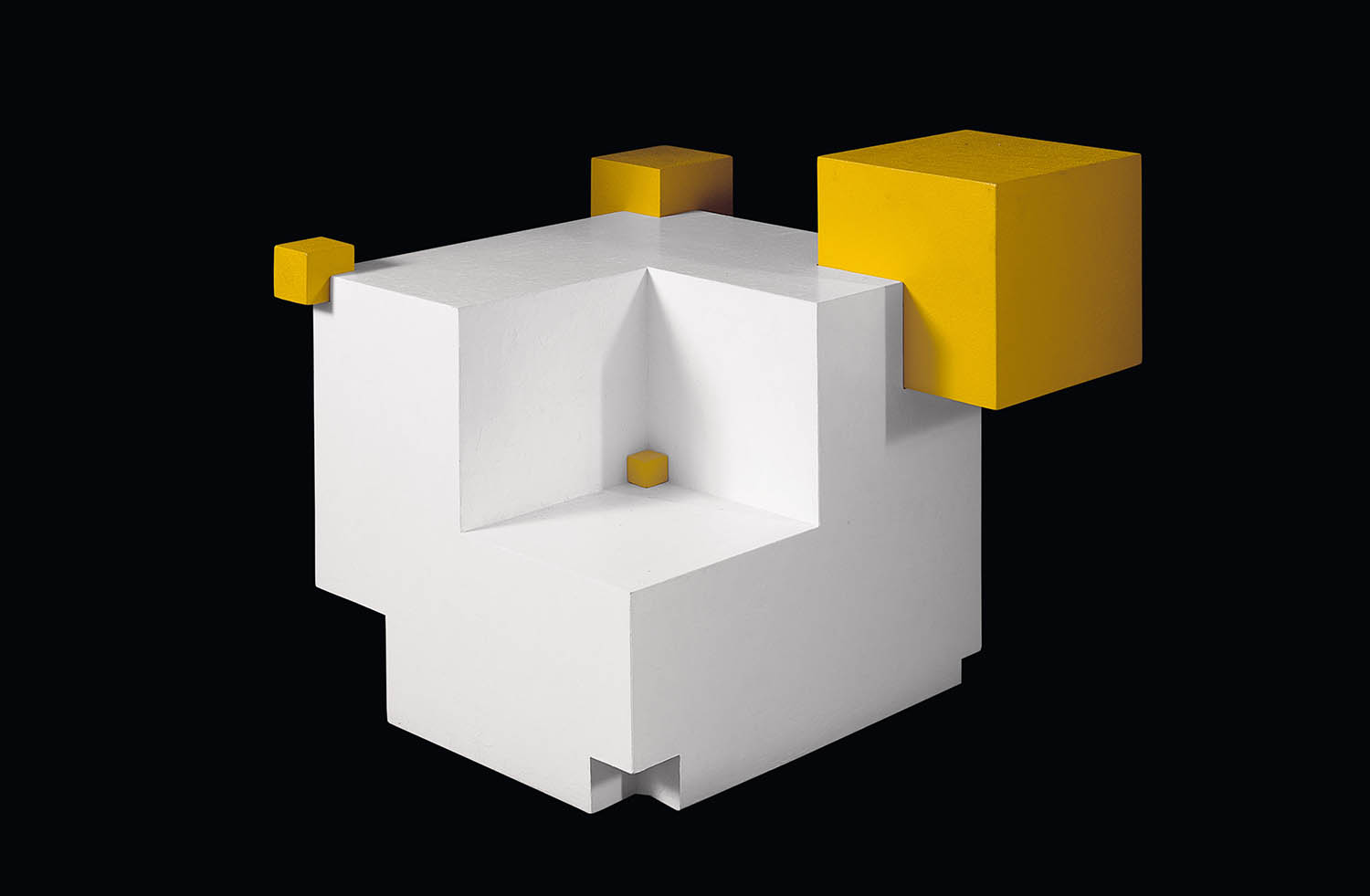
It all began in 1991 with the now famous black book, published by Jürg Nänni in collaboration with Hans Knuchel by Lars Müller Publishers. The book aroused great enthusiasm among colour lovers, thanks to its formal sobriety and conceptual rigour. It opened the way to a visual universe based on a Cartesian arrangement of primary colours, in which blue, yellow and red play the leading roles, while black and white take supporting roles.
Drawing on strict mathematical rules and geometric precision, Nänni developed a body of concrete art that long remained little known and was only recently rediscovered when his estate was settled. He knew the masterpieces of the Zurich concrete art group perfectly, and admired the rigorous chromatic compositions of Richard P. Lohse and the radical orthogonality of François Morellet, but his research went further, harnessing the power of algorithmic permutations through computer tools.
The use of random generators and cellular automata gave rise to compositions that are both unpredictable and visually striking. The result is a singular visual language – the polar opposite of traditional brush or lithography practices – which Nänni expressed through the computer keyboard, before entrusting his precise instructions to colour printers.
Thirty-five years later, the Jürg Nänni • Art & Science project offers a retrospective look at this atypical body of work, with an exhibition at the eac. alongside parallel exhibitions in Brugg and Biel, Switzerland. A comprehensive catalogue, published by Niggli, accompanies the project: it lists his works, explains his methods and theories, and highlights the breadth of his approach.
Concrete art is the common thread running through the some 1,400 recorded works, made between 1988 and 2015.
His artistic development unfolds from the first rigid compositions in primary colours to the freer structures of the 2010s: from the Cartesian grids of the early years, through the chaotic, randomly generated visual carpets of the 1990s, to the vibrant moiré waves and multicoloured free forms of his last period.
The exhibition at the eac. also features a new interactive installation: the “Colour Kiosk”, a touchscreen that allows visitors – adults and young people alike – to explore Nänni’s complex experiments on colour interactions in a playful way.
Beyond his visual works, Jürg Nänni left a complete theory of image perception, which he set out in 2008 in the book Visual Perception, also published by Niggli. In it, he develops an original line of thought on how our gaze interprets forms, contrasts and colours, extending his artistic work into a demanding scientific reflection.