János Szász SAXON, Quatre petits cubes autour du grand, 2015 Gergely Galgóczi Collection © Adagp, Paris 2026
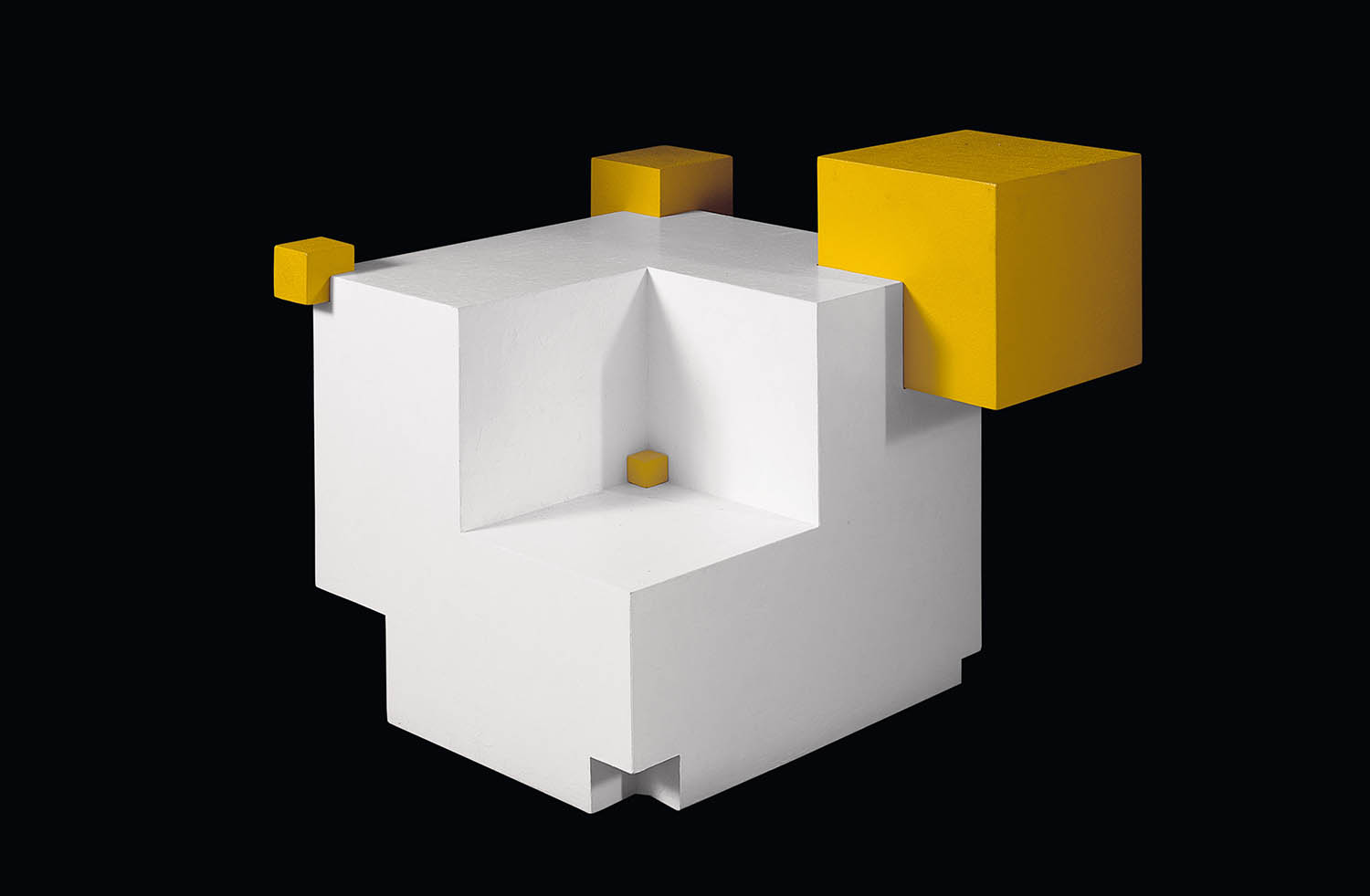
János Szász SAXON, Quatre petits cubes autour du grand, 2015 Gergely Galgóczi Collection © Adagp, Paris 2026
Exhibition organised in partnership with the Liszt Institute, Hungarian Cultural Centre, Paris
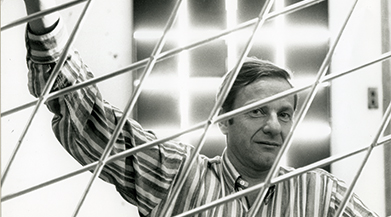
János Szász SAXON is a Hungarian visual artist born in 1964. He trained with Tibor Csiky and János Fajó, masters of Hungarian constructivism, then continued his studies in Paris with Carmelo Arden Quin, founder of the international MADI movement. The legacy of Kazimir Malevich – a major figure of 20th-century geometric abstraction and the founder of Suprematism – has deeply influenced SAXON, whose works combine geometric rigour, spirituality and a playful dimension.
Building on the traditions of constructivism and MADI, SAXON developed an autonomous artistic language from the 1990s onwards, in which geometry is not merely a form but a tool for exploring the structure of the universe. In his works, the infinitely small and the infinitely large, the nano-world and the giga-world, can become reflections of one another. As the scale changes, form reorganises itself: the whole appears in the part, while the whole in turn becomes part of new structures. This thinking links SAXON’s art to questions raised by fractal dimensions, chaos, mathematics, cosmology and contemporary philosophy.
For SAXON, however, it is not a matter of illustrating mathematics. In his work, geometry is at once a sensory and a spiritual experience, material and immaterial. Alongside precision there is play; alongside the rule, the possibility of change; and behind measurable structures, the continuity of the infinite.
It is from this thinking that SAXON’s polydimensional vision was born, appearing in his early paintings as much as in his object-paintings and spatial sculptures. In different forms, these works make visible the same fundamental question: how can a geometric form go beyond its own limits and become an element of infinite structures?
As early as his residency at the Espace de l’Art Concret in 2000, the interpretation set out in his methodological notebook entitled Dimension Crayon already emphasised the passage between dimensions, between the infinitely large and the infinitely small.
In the three spaces presented here, the series Images of the Void – Sculptures of the Void, the Poly-Universe modules and the Galaxy universe continued to develop through the artistic research carried out in Mouans-Sartoux.
The Poly-Universe game stems from this autonomous artistic thinking and is one of the singular innovations in SAXON’s work. The geometry based on changes of scale, born in the studio, was combined with colour combinations through the eac.’s education programme, then left the space of the artwork to become a playful, concrete and hands-on educational system. The same principles can thus be explored by children and adults, artists and mathematicians, each drawing on them according to their level of knowledge.
A quarter of a century after his residency at the Espace de l’Art Concret, SAXON is now returning to Mouans-Sartoux. The questions that were beginning to take shape back then have since given rise to an entire polydimensional universe that has become a common good.
Alongside SAXON’s works, the exhibition also presents a set of documents related to the Erasmus+ EarlyPoly project. The project aims to integrate the Poly-Universe educational tool, created by János Szász SAXON, into preschool education and the first years of primary school as an innovative solution.
The project was carried out by a consortium of five partners: Eszterházy Károly Catholic University in Eger, Hungary; Partium Christian University in Romania; Poly-Universe LTD in Hungary; Experience Workshop ay in Finland; and the Espace de l’Art Concret in France.
This partnership developed a learning environment and teaching practices based on cooperation, paying particular attention to inclusion and the active participation of children.
EARLY-POLY
Erasmus+ KA220-SCH-EA37DE32
European project implemented by a consortium of five partners:
Esterhazy Karoly Katolikus Egyetem, Hungary (higher education)
Poly-Universe LTD, Hungary (company)
Experience Workshop ay, Finland (company)
Universitatea Crestina Partium, Romania (higher education)
eac. - contemporary art centre of national interest, France