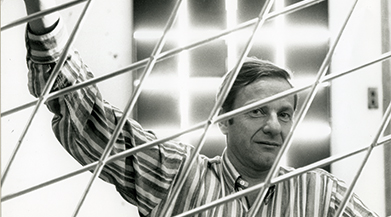
This new chapter in our rereading of the collection honours Gottfried Honegger, the founder of the Espace de l’Art Concret.
Born in Zurich in 1917, Honegger began his career as a window dresser, while painting figurative works for his own pleasure during the 1930s. He attended a preparatory class at the School of Arts and Crafts (Kunstgewerbeschule) in Zurich, going on to become a decorator, graphic designer and exhibition curator.
In 1937, Honegger opened a graphic design studio with Warja Lavater, a former student at his school, who would become his wife. Together with other Swiss artists such as Max Bill, they shared an artistic vision of advertising, which they considered a form of social art.
In the early 1950s, Honegger turned to abstraction. His compositions reflect a slow process of distilling reality, and the signs they offer still carry the memory of tangible objects evoked in their titles. Yet the compositions already display very assertive structures, marked by contrasts of form, material and colour. Gradually, nature became a major source of inspiration, through which the artist analysed the relationship between art and nature.
Already seeking to curb personal expression in creation, Honegger began to make room for chance, which also governs nature’s own creative processes. His work then tended towards a simplification of forms. Inspired by photographic enlargements of microscopic views, he gave up depth of field and perspective, reducing spatial structure to a surface. Signs became autonomous and formed structures. In 1956–1957, Honegger abandoned any anchoring in reality to commit definitively to abstraction. Although close to the Zurich concrete artists, he remained attached to the pictorial and was still opposed to applying predetermined programmes. His paintings became untitled compositions whose surface is divided into more or less contrasting fields of colour, some offering a white grid that covers the underlying flat areas of colour.
Honegger turned away from the dominant current of gestural painting, and his works are closer to counter-movements such as those that emerged at the end of the 1950s, notably the NUL and ZERO groups, some of whose representatives, such as Ad Dekkers and Jan J. Schoonhoven, are featured in the Albers-Honegger collection.
In 1957, he made his first Tableaux-Reliefs: “I wanted to make an art that, while using a determined geometry, would be individualistic. Introducing relief catches the light on the canvas. Light, which is changeable, alters the composition: it introduces chance. In this way, I was able to marry determinism and chance.”
By gluing onto canvases pieces of cardboard cut according to a predefined grid, which he then covered with several layers of monochrome paint, the painting became nothing more than planes and colours, referring to nothing but itself, echoing the principles of concrete art theorised in 1930 by Theo van Doesburg.
Honegger nevertheless moved away from concrete art by using chance as a creative process, notably through dice or computer systems composing random drawings. This approach set him apart from Zurich concrete artists such as Max Bill and Richard Paul Lohse, whose works are created according to precise predefined systems.
In 1958, after a trip to New York, he gave up graphic design to devote himself fully to his work as an artist. His travels and international exhibitions brought him into contact with many artists in Europe and the United States, who were both an influence on his artistic practice and the source of a large part of the collection of geometric abstract art he built with his partner Sybil Albers.
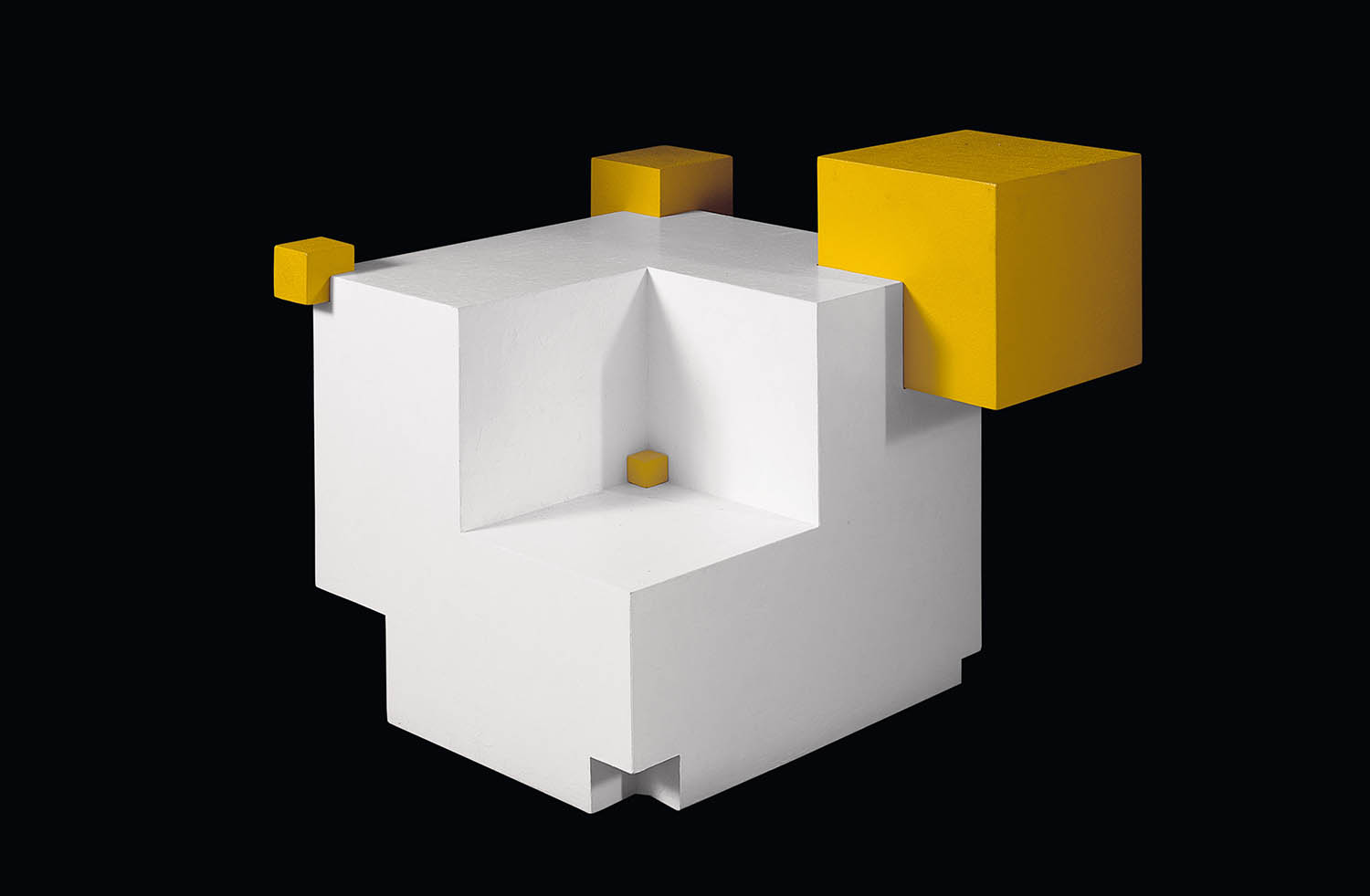
In the early 1990s, the artist broke free from painting in the classical sense and abandoned the idea of the picture, beginning to make aluminium “objects”.
Echoing the issues first explored by conceptual and minimal artists, he distanced himself from the know-how traditionally implied by the painter’s craft and gesture, making his sculptures with industrial techniques and materials. Paint was soon reintroduced at the heart of the work, but forms now appeared standardised and colour was applied mechanically.
Begun with his Tableaux-Espaces, his reflection on the dialogue between the work and architectural space became central. The coloured surfaces were increasingly hollowed out to reveal the wall supporting the relief. The viewer’s movement became part of the work, leading to a reflection on contemplation and on the world around us.
Beyond his artistic practice, Honegger was also a collector. With his partner Sybil Albers, he built a collection representative of the many trends in geometric abstraction. This richness fosters a constant dialogue between works from different backgrounds, between theoretical propositions and specific sociological and political contexts.
True to the universalist spirit of concrete art, the collectors did not limit their collection to purely geometric works. They broadened its scope by reflecting on the most striking, and sometimes surprising, developments of the 20th century, making their collection a work in its own right. This free, almost impertinent outlook is the very foundation of the collection, amplifying its historical reach through the discovery of unexpected territories.
In 1990, Gottfried Honegger and Sybil Albers decided to create the Espace de l’Art Concret in the Château de Mouans-Sartoux, and in 2002 they donated the collection to the French State. Donations from artists such as Aurelie Nemours were later added, highlighting the artists’ ties with the venue.
Gottfried Honegger wanted to educate children’s artistic eye from a very young age, in order to move away from a society too focused on consumption and too little on creation and aesthetics.
He thus developed artistic educational tools such as the Jeu du viseur (Viewfinder Game), the Écouteur (Listener) and the Jeu du Carré (Square Game), helping audiences learn to look, in the sense of “getting the gaze to become creative and not merely consumerist”.
The many public commissions he carried out also reflect this social approach. His notable works include stained-glass windows (Nevers Cathedral,
the church of St André in Mouans-Sartoux), in which Honegger succeeded in fusing an art integrated into architecture with a reconciliation of form and colour through light: “We need works that are integrated into architecture and into everyday life, so that we are constantly in the presence of the beauty of art.”